Free SSL vs Paid SSL: What's the Difference?
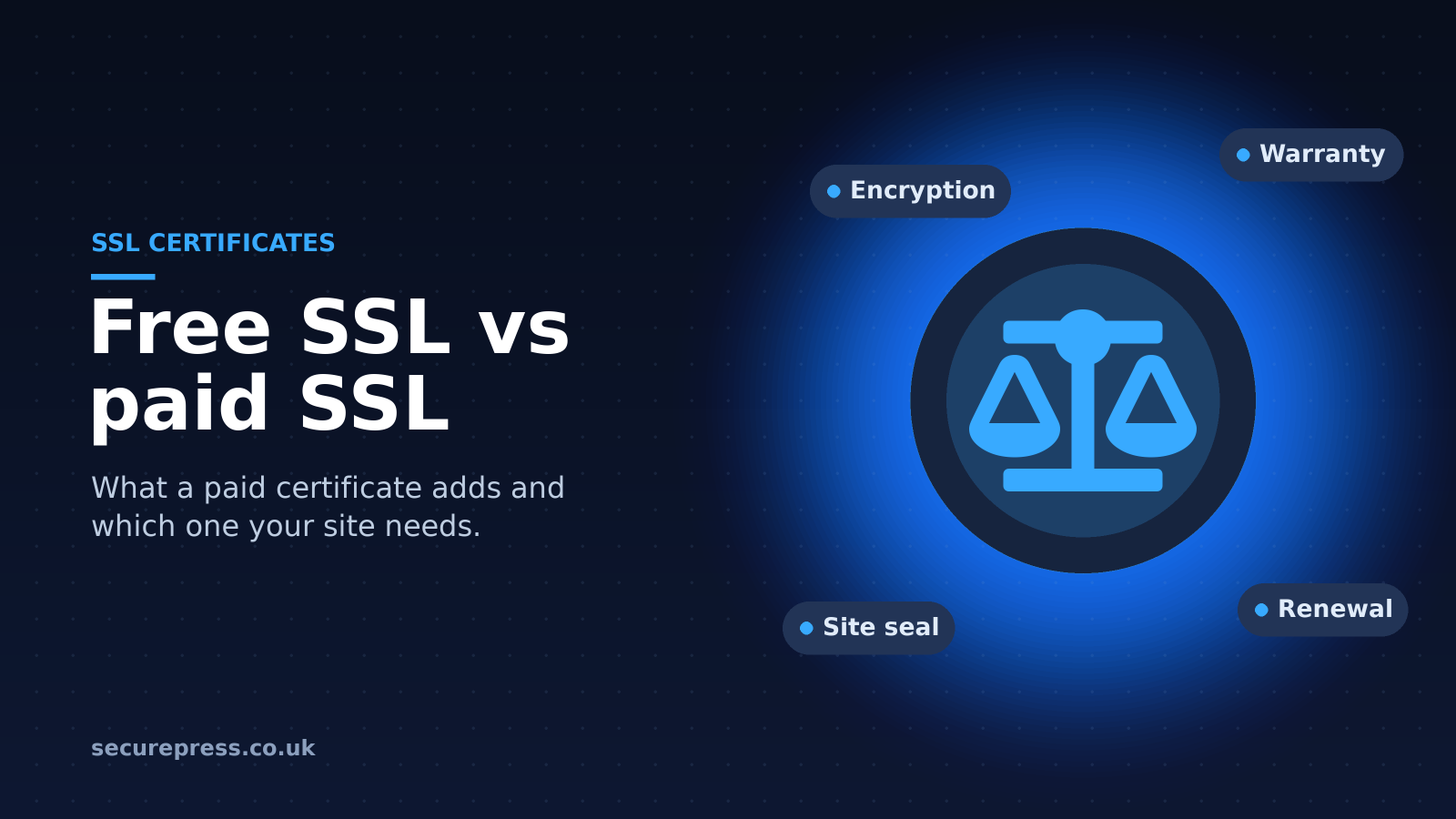
Free SSL and paid SSL certificates encrypt your site just as strongly. Here's what a paid certificate adds, and how to tell which one your site needs.
Every website should run on HTTPS. It protects what visitors send you, it puts the padlock in the address bar, and browsers now warn people away from sites without it. The good news is that you don't have to pay for it: free certificates are widely available and many hosts set one up automatically. So where does a paid certificate fit in?
What every SSL certificate does
Free or paid, an SSL certificate does the same core job:
- It encrypts the connection between your visitors and your website, so passwords, card details and form messages can't be read on the way.
- It gives you the padlock and the https:// address that browsers expect to see.
- It counts the same with Google. HTTPS is a small ranking signal, and a free certificate earns it just as well as a paid one.
The encryption is just as strong either way. A free certificate isn't a weaker kind of security.
What a free certificate gives you
Free certificates, like those from Let's Encrypt or cPanel's AutoSSL, are issued automatically once it's been checked that you control the domain. They only last a short time, usually 90 days, so they renew themselves in the background. When that works, you never notice. When it doesn't, for example after a change to your domain's settings, the certificate can quietly run out and visitors see a security warning instead of your site.
What a free certificate doesn't come with is anyone standing behind it: no warranty, no site seal and nobody to call if it goes wrong.
What a paid certificate adds
- A warranty. If the certificate authority makes a mistake issuing it and one of your customers loses money because of it, the warranty pays out.
- A site seal. A badge for your checkout, booking or contact pages that shows visitors the certificate is genuine.
- A known name behind it. The certificate comes from an established certificate authority that stands behind it commercially.
- More checks, if you need them. Some paid certificates also verify your organisation, not just your domain, and include your company's details in the certificate.
- Someone looking after it. Bought through your host, a paid certificate is usually installed and renewed for you, so you're not relying on an automatic renewal you never see.
One thing has changed for every certificate, free or paid: since March 2026, none can last longer than 200 days, and the limit falls further in 2027 and 2029. A paid certificate is still bought by the year, but it's reissued during that year.
Which one does your site need?
For a blog, a portfolio or a brochure site that doesn't take payments or personal details, a free certificate is usually all you need.
A paid certificate is worth considering if:
- you sell online or take payments,
- you collect personal details, such as enquiries, bookings or customer accounts,
- your customers want to see who stands behind your site, or
- you'd rather have a warranty and someone making sure it never lapses.
SSL at SecurePress
Every SecurePress hosting plan includes a free SSL certificate. If your site needs a paid one, we supply a Sectigo SSL certificate, with its warranty and site seal, and install it for you free of charge. You can see what's included and the price here.
Not sure which suits your site? Get in touch or call us on 0333 020 0530 and we'll help you decide.